
Posted on Leave a comment

Add fan in APC Smart UPS 1000 (sui1000i)


During power outages in Ukraine (fuck fucking ruzz nazis), there is a need to modify standard UPSs for powerful batteries. The most common and very good model is the SUI1000i. It gives a pure sine wave and has a charge of up to 4 amperes.

But there is a nuance. No UPS is designed to deliver power for a long time. Cooling is needed. The SUI1500i model is fundamentally no different from the 1000 model. It has a cooler for cooling and a larger transformer. There are no more differences.

Of course, it was possible to add cooling by simply connecting a cooler – but this is not our method) Therefore, we will add part of the circuit from the SUI1500i to the SUI1000i. There are free places on the board.

(Підчас відключень світла в Україні (хай повиздихують йобані москалі), є необхідність переробки стандартних безперебійників під потужні акб. Найбільш розповсюджена і дуже хороша модель apc sui1000i. Вона дає чисту синусоіду та має зарядку до 4 ампер. Але є нюанс. Жоден безперебійник не розрахований на віддачу потужності тривалий час. Треба охолодження. Модель apc sui1500i принципово нічим не відрізняється від 1000 моделі. в ній є кулер для охолодження та більший трансформатор. Більше відмінностей немає. Можна звісно було додати охолодження просто підʼєднавши кулер – але це не наш метод) Тому додамо частину схеми від sui1500 в sui1000. Тимпаче на платі є вільні місця)


Schematic APC 640-7732H ver.9 SMART-UPS 1000 SMART-UPS 1500

Continue reading Add fan in APC Smart UPS 1000 (sui1000i)
Posted on Leave a comment

S-meter and signal strength

For frequencies below 30 MHz, S9 is defined as a voltage of 50 μV over 50 Ω at the receiver antenna connector; for frequencies above 30 MHz, S9 is defined as a voltage of 5 μV over 50 Ω at the receiver antenna connector. This refers to an unmodulated carrier signal (N0N) that uses almost no bandwidth; in case of real signals using a given bandwidth, this definition may not be enough since a smaller receiver bandwidth allows a weaker minimum detectable signal, but S-points are still a good tool for comparing received signals.

Continue reading S-meter and signal strength
Posted on Leave a comment

Icom IC7100 Panadapter (2nd receiver) – rf tap

Автор не несе жодної відповідальності за повторення. Якщо ви не маєте навиків модифікації такої апаратури, краще не повторювати.

(The author does not bear any responsibility for repetition. If you do not have the skills to modify such equipment, it is better not to repeat.)

Додавання другого приймача полягає в підʼєднанні sdr приймача в точку переходу RF між PA та MAIN платами.

Сигнал в цій точці -30dBm (~S9+40) що на приймання що на передавання. Це трохи забагато для SDR приймача, тому треба ставити атенюатор 10дб.

(Adding a second receiver involves connecting an SDR receiver to the RF transition point between the PA and MAIN boards. The signal at this point is -30dBm (~S9+40) both for reception and transmission. This is a bit too much for an SDR receiver, so you need to put a 10dB attenuator.)

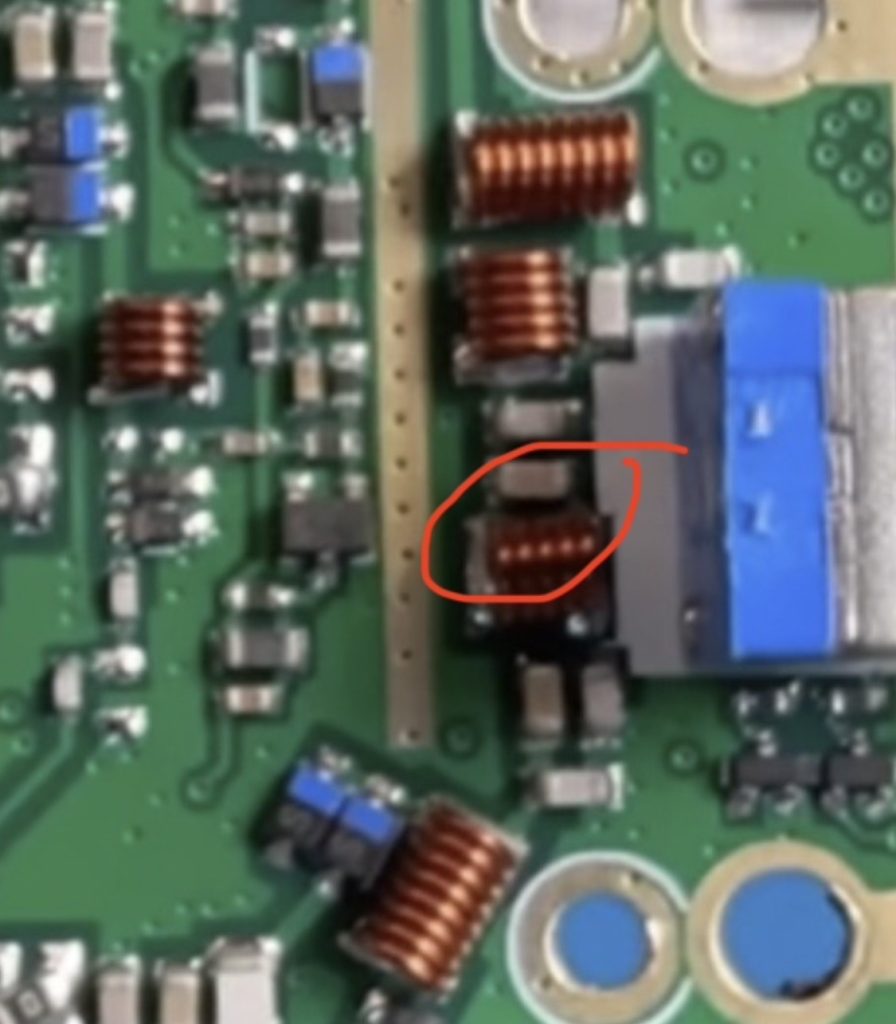
Наша потрібна точка це J3001. З двох сторін по схемі ця точка має блокування по напрузі конденсаторами.

The point we need is J3001. On both sides of the circuit, this point has voltage blocking by capacitors.
Continue reading Icom IC7100 Panadapter (2nd receiver) – rf tap
Posted on Leave a comment

Handmade analog Icom CR-282. For IC-706MK2G

1. TL431 
2. Two resistors 300 Оhм, 1 wt. 
3. Thermoresistor 10коhм 
4. Resistor 10 кhом 
and thats all.
TL431 is an adjustable zener diode, with an allowable current of 100 mA.
so … we don’t need anything else.
the circuit is very simple.

resistors R3, R4 and thermistor must have thermal contact with the quartz resonator case. (pressed through thermal paste)

you may have to choose a resistor R1 to achieve a stabilization temperature of 50-60 degrees.

The scheme works as follows.
when voltage is applied, a current of about 80-90 mA flows through an open zener diode and heating resistors R3, R4, which causes heating of the resistors and the case of the quartz generator.

As the temperature heats up and approaches the working temperature, the resistance of the thermistor decreases, which leads to a smooth closing of the zener diode … and a decrease in the current through the heating resistors .. the system comes to equilibrium .. The heat outflow is compensated by a small current through the heater, which is automatically maintained at the desired level so that the temperature remains stable.
The temperature of the quartz generator case is maintained with very high stability .. not worse than 0.5 С °

the board is installed in the regular place of CR-282, right on top of the native quartz.

author R6CDU